This is my final post on this blog. My summer renewal leave (sabbatical) is over and I'm fully engaged into the 2nd half of ministry. I'll continue blogging at www.jaraker.blogspot.com under the title "Guard Your Heart."
I hope you'll continue to follow me as I seek to honor the name of Jesus with a heart fulled devoted to Him.
Be blessed - Be a blessing
Friday, September 7, 2012

Into the 2nd Half
The locker room at halftime is a time to assess, encourage, challenge, refine the orginial plans and figure out how to make the second half better than the first. The opponent brought some new plays, tried some different things than were seen on the game film. Halftime is a time for shifting.
 I feel like I've come out of the locker room and begun my second half. This past week back has been filled with re-connecting, sharing stories, listening to plans that have been made and some difficulties that have been encountered.
My personal focus has been on resisting old routines. In this unique, once in a lifetime opportunity, I don't want to simply go back to the first half when not everything in the first half worked.
Now is the time to apply some lessons from the summer. So I made a choice to concentrate on my calendar, applying three lessons I learned this summer as I create something new.
I have a quote on my desk, sitting next to a compass:
I have found that if I push off my study and writing time to the afternoon, it becomes sporadic and frankly just not that good.
Lesson 2 - I need to read. I've known it and I've read about it but over the last few years reading got lost in my calendar. Leaders are learners and one of the best ways to learn is to read. I've established a goal of reading books to grow my mind, my heart and my health. Theology, spiritual life, physical health and the Colonial era are the kinds of books I either enjoy or I need. But there is another piece - reading out of my discipline. Innovative leaders want to know how others think and operate in other fields.
Lesson 3 - White space is important.
In his book, The Next Level, Scott Eblin writes about white space on your calendar. Eblin says that research shows those who have white space have a greater ability to think creatively and strategically. Prior to reaching the executive level your calendar might have been filled with meetings, lots of meetings. But if meetings fill the executives life there will be no room for first thinking, second creating and third making those decisions that come to you.
As I create this 2nd half calendar, I'm leaving white space.
Where are you going? What is filling your calendar? Is yoru calendar taking you where you want to go?
I love being back at Cornerstone. I said it in May and I still believe it - Cornerstone is the best church I know. We're not perfect. We've got our issues. But God's Spirit is at work in and through us. I'm excited about what is next.
I feel like I've come out of the locker room and begun my second half. This past week back has been filled with re-connecting, sharing stories, listening to plans that have been made and some difficulties that have been encountered.My personal focus has been on resisting old routines. In this unique, once in a lifetime opportunity, I don't want to simply go back to the first half when not everything in the first half worked.
Now is the time to apply some lessons from the summer. So I made a choice to concentrate on my calendar, applying three lessons I learned this summer as I create something new.
I have a quote on my desk, sitting next to a compass:
Lesson 1 - mornings are my best time for study and writing. Over the next few weeks I'm going to discuss with staff some changes to what has been our "normal" schedule.It's the compass that matters more than the calendar. It's the direction you're going that matters more than the speed with which you are getting there.
I have found that if I push off my study and writing time to the afternoon, it becomes sporadic and frankly just not that good.
Lesson 2 - I need to read. I've known it and I've read about it but over the last few years reading got lost in my calendar. Leaders are learners and one of the best ways to learn is to read. I've established a goal of reading books to grow my mind, my heart and my health. Theology, spiritual life, physical health and the Colonial era are the kinds of books I either enjoy or I need. But there is another piece - reading out of my discipline. Innovative leaders want to know how others think and operate in other fields.
Lesson 3 - White space is important.
In his book, The Next Level, Scott Eblin writes about white space on your calendar. Eblin says that research shows those who have white space have a greater ability to think creatively and strategically. Prior to reaching the executive level your calendar might have been filled with meetings, lots of meetings. But if meetings fill the executives life there will be no room for first thinking, second creating and third making those decisions that come to you.
As I create this 2nd half calendar, I'm leaving white space.
Where are you going? What is filling your calendar? Is yoru calendar taking you where you want to go?
I love being back at Cornerstone. I said it in May and I still believe it - Cornerstone is the best church I know. We're not perfect. We've got our issues. But God's Spirit is at work in and through us. I'm excited about what is next.
Sunday, September 2, 2012
Guarding My Heart
How great is Cornerstone Church? I don't know how many Pastors receive a standing ovation from their congregation but I was blessed and honored today with one. I know it wasn't deserved but that's the kind of people who make up Cornerstone. One couple delayed a trip for a daughter's birthday, just to be in worship on this day. It was a humbling morning.
Are we perfect? By no means. Some people find Cornerstone unfriendly. Some consider us unBiblical or at least unfocused or misdirected. Proof that we're not for everyone and we need every congregation in the community to reach the community.
I'll be re-directing this Blog in a few days, perhaps as long as a week, to something for the long haul. I'm considering the title: "Guard your heart." This is a message that has been hammered home loud and clear.


Are we perfect? By no means. Some people find Cornerstone unfriendly. Some consider us unBiblical or at least unfocused or misdirected. Proof that we're not for everyone and we need every congregation in the community to reach the community.
I'll be re-directing this Blog in a few days, perhaps as long as a week, to something for the long haul. I'm considering the title: "Guard your heart." This is a message that has been hammered home loud and clear.

Above all else, guard your heart, for
it is the wellspring of life.
Proverbs 4:23
Our hearts are the core of our lives. Nurture and grow the heart and life grows. Allow infection, i.e. sin, to reside in the heart and it blows holes that will destroy.
My heart is guarded when....
- I'm at rest in my salvation
- I'm surrendered to God's will
- I'm aware of my weaknesses
- I'm accountable to others for my spiritual growth
- I'm regularly filling my life with God's Word
- I confess my sins
- I'm in relationship with a local church for worship, study and community
- I pray with a thankful heart
Do not be anxious about anything, but in everything, by prayer and petition, with thanksgiving,
present your requests to God.
7 And the peace of God, which transcends all understanding, will guard your hearts
and your minds in Christ Jesus.
Philippians 4:6-7
That's not an exhaustive list but how will you guard your heart today? This summer has been key to helping me guard my heart. I also know that I must change some of my routine in order to guard it into the future. What do you need to do differently to guard your heart?
Friday, August 31, 2012
Final Philadelphia Photos
I loved Philadelphia, especially getting to stay in Old Town with an easy walk from the 1769 B & B to the spot where Independence grew. For me it never gets old (no pun intended). To know what our Founding Fathers did, the courage it took, the risk involved and the sometimes blind luck that supported them, encourages and challenges me. So here are a few final photos from the last days.
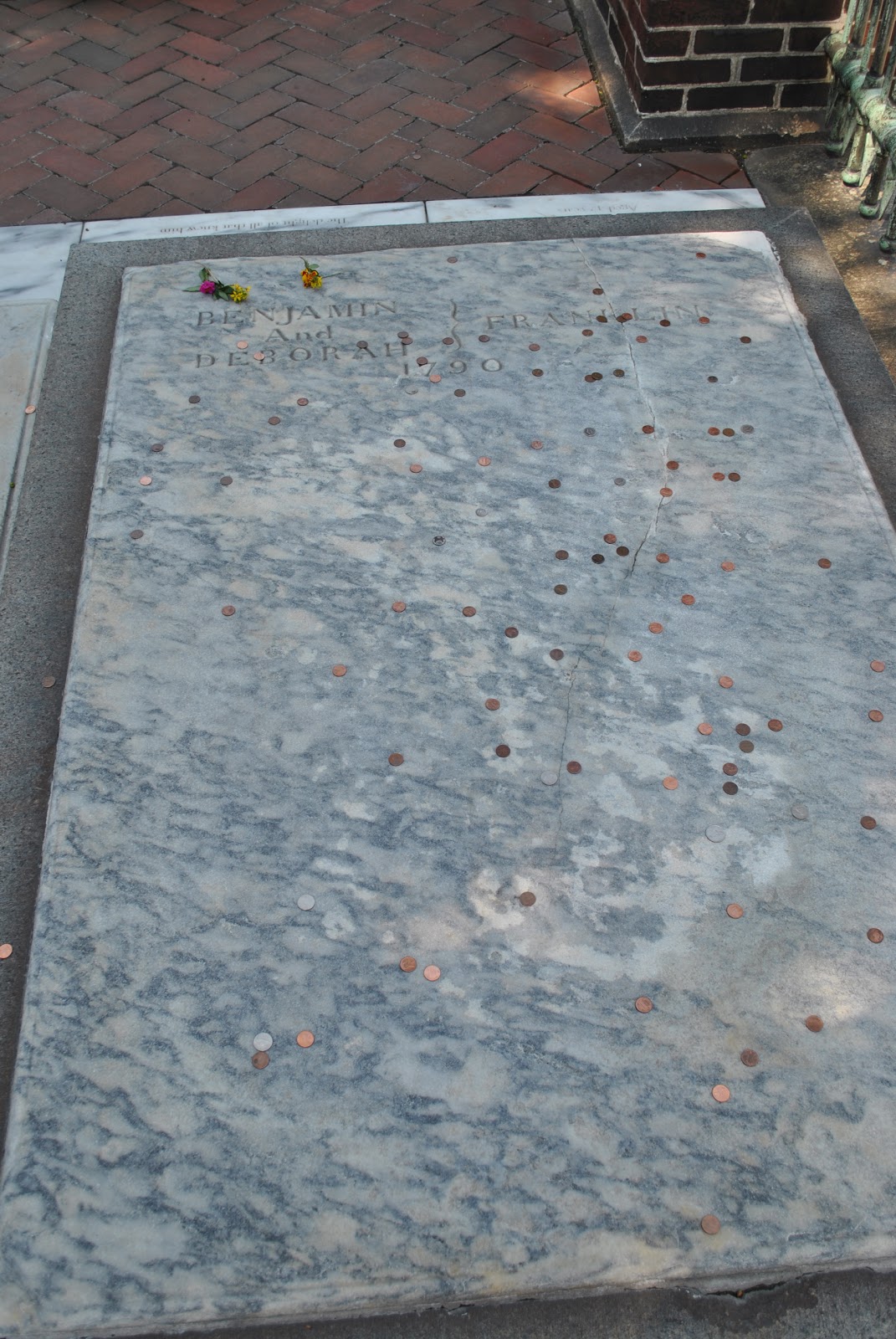 |
| Benjamin Franklin's simple gravesite |
 |
| Elfreth's Alley - the oldest residential street |
 |
| On Elfreth's Alley with stained glass window of books and an inkwell |
 |
| Independence Hall @ 2:22 p.m. and the sun isn't in the right place |
The National Constitution Center was something new since my last visit to Philly. I was impressed as it tells the story of "We the people...." It is a well-done telling of the history of our Constitution and a history museum. I was skeptical of the last display, a replica of Signer's Hall with life-sized statues of the delegates. It turned out to be stunning, feeling like you were really there as much as can be 225 years later. You can check out a live webcam @ http://constitutioncenter.org/webcam
 |
| Washington is behind the desk |
 |
| Franklin and others |
Thursday, August 30, 2012
The Last Days
Are we in the last days? The end times the Bible talks about? Wars & rumors of wars....earthquakes and famines? Sure can seem like it but those aren't the last days on my mind. If THE last days are anything like these last days of Sabbatical, then there is great anticipation ahead, thankfulness for what has been and looking forward to what lies ahead.
Many Christ-followers live to anticipate and figure out the Biblical Last Days. They are mysterious, a bit foggy in our sight with clues and questions surrounding them. If MY last days are anything like THOSE Last Days, then I might have some insight into how to approach them.
1. I know where I'm going next. It's a helpful thing. I remember one day in particular when Stephanie and I knew God was leading us to move from a place and we didn't have any idea where we were going. That fact caused stress. We're riding in the car and "our song" comes on - "I Will Be Here" by Stephen Curtis Chapman. One line says: "Tomorrow monrin' if you wake up - And the future is unclear - I....I will be here." I choked, literally. It hit me like a ton of bricks because that's where we were.
I know Cornerstone awaits me in a few days. I knew that 3 months ago as well as I know it 3 days from now. As certain as I've been about that, I can be certain about eternity. I don't fear tomorrow and I've been able to enjoy each day because I know what lies at the end. Am I as certain of eternity as I am of the end of the Sabbatical? God wants me to be I think.
 2. Community. God created us to live in community with others. The community of my family - which has reconnected in new ways even as we've added one to our number this summer - has been a centerpiece of this time. But also the community of Cornerstone and the staff. I know of their love and support for this time. I know how capable the individuals and collective group are for ministry. It's important to have fellow travelers on this journey. I have been able to enjoy today and not worry about tomorrow because of them.
3. Sabbath is crucial. I've written on this numerous times and imagine I'll keep coming back to it. The big picture perspective and re-ordering of our hearts that Sabbath provides is an essential tool to keep us focused on Him. I've seen how I've allowed petty things to dominate my thinking and time. I've witnessed the truth of my dispensability creating a deeper humility. I imagine some people might say: "Back so soon!!" because of the great leadership and teaching Cornerstone has experienced this summer. In fact, I'm not sure how I'm getting into the building on Sunday morning. I have no key and have no doubt my door code is disabled. Maybe it'll be a sign!!
 I've realized how easily God becomes shrouded in a fog of pettiness, busyness and concern for secondary things.
Sabbath - this longer Sabbatical in this case - has helped me re-gain perspective, re-new my call, and re-center my life to Jesus as Lord. He is Lord but life is good at helping us forget that. The Last Days don't matter as to when and how as much as my Lord matter today. If He's in the center of my life, last day or not, I'm good.
I'm going to think some more on this. Some of this will re-appear in a post on lessons learned which I've been crafting all summer.
For now, I'm enjoying this last day. So much so that I'm off to capture a photo @ 2:22 p.m, which my family will appreciate - and laugh!
Many Christ-followers live to anticipate and figure out the Biblical Last Days. They are mysterious, a bit foggy in our sight with clues and questions surrounding them. If MY last days are anything like THOSE Last Days, then I might have some insight into how to approach them.
One of my biggest lessons, I think, is this: Don't worry so much about tomorrow. A favorite scripture of those who find worry a close friend is Matthew 6:34...
Therefore do not worry about tomorrow,
for tomorrow will worry about itself.
Each day has enough trouble of its own.
Tomorrow is coming. There's no stopping it unless today is THE Last Day and I have no control over that timing. I am enjoying today just like I've enjoyed each day this summer - even the day I nearly spent more days in Costa Rica (see Making An Exit). So here are some thoughts that come from this big lesson.
1. I know where I'm going next. It's a helpful thing. I remember one day in particular when Stephanie and I knew God was leading us to move from a place and we didn't have any idea where we were going. That fact caused stress. We're riding in the car and "our song" comes on - "I Will Be Here" by Stephen Curtis Chapman. One line says: "Tomorrow monrin' if you wake up - And the future is unclear - I....I will be here." I choked, literally. It hit me like a ton of bricks because that's where we were.
I know Cornerstone awaits me in a few days. I knew that 3 months ago as well as I know it 3 days from now. As certain as I've been about that, I can be certain about eternity. I don't fear tomorrow and I've been able to enjoy each day because I know what lies at the end. Am I as certain of eternity as I am of the end of the Sabbatical? God wants me to be I think.
3. Sabbath is crucial. I've written on this numerous times and imagine I'll keep coming back to it. The big picture perspective and re-ordering of our hearts that Sabbath provides is an essential tool to keep us focused on Him. I've seen how I've allowed petty things to dominate my thinking and time. I've witnessed the truth of my dispensability creating a deeper humility. I imagine some people might say: "Back so soon!!" because of the great leadership and teaching Cornerstone has experienced this summer. In fact, I'm not sure how I'm getting into the building on Sunday morning. I have no key and have no doubt my door code is disabled. Maybe it'll be a sign!!
Sabbath - this longer Sabbatical in this case - has helped me re-gain perspective, re-new my call, and re-center my life to Jesus as Lord. He is Lord but life is good at helping us forget that. The Last Days don't matter as to when and how as much as my Lord matter today. If He's in the center of my life, last day or not, I'm good.
I'm going to think some more on this. Some of this will re-appear in a post on lessons learned which I've been crafting all summer.
For now, I'm enjoying this last day. So much so that I'm off to capture a photo @ 2:22 p.m, which my family will appreciate - and laugh!
Tuesday, August 28, 2012
Duped by Hollywood
Another great day in Philadelphia, but along the way I got duped.
I had a great morning walk down to the Franklin Institute to see the Dead Sea Scrolls exhibit now on display. While I was excited about that I was also looking forward to seeing the Silence Dogood letters, you know, the ones from National Treasure fame. I saw the bench area where "Riley" sat as the young african-american boy retrieved the secret code from the letters shown displayed in the front lobby of the Franklin Institute.
I walked up the stairs and to my surprise, no letters, only a huge statue of a seated Ben Franklin (whose birthday I share by the way - me, Franklin and Al Capone!). I'd been duped. The Silence Dogood letters are housed in the National Archives in Washington, D.C. Rats!
But I still hope to get a photo of the Independence Hall tower clock at 2:22 p.m. before I leave!
National Treaure has become somewhat of a cult classic in the Raker household. We took a Colonial-theme family vacation not long before it was released, getting to see again many of the places we visited. There is also a striking resemblance of one of our family members to one of the movie characters, but that's not for publication.
Hollywood can make things appear where they are not and lead us to believe that which is not accurate. If we swallow everything we see and hear without some critical thinking, we could easily be led astray in our thinking and therefore the way we live.
The Dead Sea Scrolls exhibit contained much more than just parchment bits and information about the Scrolls themselves. It was a story of the Jewish people from a wonderful Biblical foundation, following their history through archaeological finds.
I became most interested in the displays of household gods, goddesses and altars. Here before my eyes was the duping of Israel to follow false gods. The archaeological evidence is overwhelming confirmation of the Biblical texts. Throughout the Old Testament we read about Israel going after other gods but most especially it seems through the reign of King Jeroboam, Son of Nebat. He is most infamous for leading Israel astray in worship.

Worship was to take place in only one place, the Temple in Jerusalem, the dwelling place of God with the Ark of the Covenant. New Testament worship is far different but in the Old Testament it was about sacrifices, an altar and a place. God had appointed a specific place and a specific people, the Levites, to administrate worship. Jeroboam, for fear he would lose his throne, built places of worship in Israel (the northern kingdom) so that his people wouldn't have to go to Jerusalem (in the southern kingdom of Judah).
The people were duped by a king. The king chose to ignore God's Word, duped by the hollow promises of power and title.
The actions of Jeroboam had a profound and lasting effect on the kings that followed him. Scripture describes those kings in the context of Jeroboam's sin: "Nevertheless he clung to the sins of Jeroboam son of Nebat, which he had caused Israel to commit; he did not turn away from them." (2 Kings 3:3). This thread is found in 1 Kings 14-16, 21-22; 2 Kings 3, 9-10, 13-15, 17 & 23, not to even mention the book of Amos which railed against the house of Jeroboam.
God is clear that there is no other god besides Him. Scripture consistently draws the contrast that our God hears and sees and understands and is actually able to help His people.
Daniel 5:23 talks about the "gods of silver and gold, of bronze, iron, wood and stone which cannot see or hear or understand."
Jeremiah 2:26-28 refers to the apostasy of Judah following other gods:
 |
| View from the steps of the Franklin Institute |
I walked up the stairs and to my surprise, no letters, only a huge statue of a seated Ben Franklin (whose birthday I share by the way - me, Franklin and Al Capone!). I'd been duped. The Silence Dogood letters are housed in the National Archives in Washington, D.C. Rats!
But I still hope to get a photo of the Independence Hall tower clock at 2:22 p.m. before I leave!
National Treaure has become somewhat of a cult classic in the Raker household. We took a Colonial-theme family vacation not long before it was released, getting to see again many of the places we visited. There is also a striking resemblance of one of our family members to one of the movie characters, but that's not for publication.
Hollywood can make things appear where they are not and lead us to believe that which is not accurate. If we swallow everything we see and hear without some critical thinking, we could easily be led astray in our thinking and therefore the way we live.
The Dead Sea Scrolls exhibit contained much more than just parchment bits and information about the Scrolls themselves. It was a story of the Jewish people from a wonderful Biblical foundation, following their history through archaeological finds.
I became most interested in the displays of household gods, goddesses and altars. Here before my eyes was the duping of Israel to follow false gods. The archaeological evidence is overwhelming confirmation of the Biblical texts. Throughout the Old Testament we read about Israel going after other gods but most especially it seems through the reign of King Jeroboam, Son of Nebat. He is most infamous for leading Israel astray in worship.
Jeroboam built shrines on high places
and appointed priests from all sorts
of people, even though they
were not Levites.

 |
| 4 horned altar - oldest object in this collection |
 |
| Incense altars for use in the home |
Even after this, Jeroboam did not change
his evil ways, but once more appointed priests
for the high places from all sorts of people.
Anyone who wanted to become a priest he
consecrated for the high places.
34 This was the sin of the house of Jeroboam
that led to its downfall and to its destruction
from the face of the earth. - 1 Kings 13:33-34
 |
| 4 horned altar uncovered at Dan |
 |
| Household gods & goddesses |
Daniel 5:23 talks about the "gods of silver and gold, of bronze, iron, wood and stone which cannot see or hear or understand."
Jeremiah 2:26-28 refers to the apostasy of Judah following other gods:
They say to wood, ‘You are my father,’
and to stone, ‘You gave me birth.’
They have turned their backs to me
and not their faces;
yet when they are in trouble, they say,
'come and save us!'
 |
| Household gods & goddesses - a 2nd view |
 |
| Heads of household gods & goddesses |
I was duped by Hollywood. God and I are dealing with where I've been duped by other gods. What about you? Are there other gods you follow? Money, sex and power come to mind easily. What about image? or a method of worship? Other gods promise power and self-confidence, feeling good and fulfilled dreams but in the end they are unable to deliver and unable to save.
“There is no one holy like the LORD; there is no one besides you; there is no Rock like our God.
Monday, August 27, 2012
Rev. Francis McCormick
When you cross something off your bucket list there is a combination of fulfillment, excitement, the taking of a deep breath and a question: was it all I expected it would be?
I sat down in the St. George's UMC for about 3 hours to read through the journal of Rev. William Jessop, a Methodist circuit rider in the last 1700's. The journal covers only two years from 1790-1791. Why this journal? Jessop was the first Methodist my subject, Francis McCormick, remembered hearing. Besides, to hold something that old in your hands and think about the history it contains is one thing. To hope for a connection to McCormick was another......that didn't happen. It was the best shot I've uncovered in my research but it appears the journal is a year or two too late.
After many years of waiting and a few months of contact and planning I got to cross one thing off my list today and had all those things. For some people, old books and old buildings are just that - old. My children are beginning to refer to me as old so perhaps I belong there anyway.
 |
| Rev. William Jessop's Journal - 1790-1791 |
McCormick came to faith in late 1790 becoming a powerful force for the Kingdom in bringing the Gospel to the Northwest Territory, across the Ohio. He founded the first Class Meeting (small group) in 1797 at Milford before helping found what is today Armstrong Chapel UMC before finally settling in Salem, on the east side of Hamilton County to lead what is now the Salem UMC. He's buried in the Salem Church cemetery.
I did discover something in my reading, one of the last letters sent by John Wesley, the Father of Methodism. On Tuesday, April 5, 1791, Jessop copied the letter (dated February 1) into his journal. Wesley died on March 2nd. For a history buff, that was a really cool find.
People like - or dislike - history for different reasons. I like it because I enjoy uncovering connections, understanding events and also why things turned out the way they did. The history of a person or organization colors who and what they become. We are products of our environments, for good or ill. Not completely but where we live, our family, our choices for activity all factor into who we become.
People who grow up sufring are different from people who grow up on a farm. People who are from Texas are different from those who lived in Vermont.
History will usually tell you why things are as they are today. Cornerstone Church is a product of being in West Chester, planted at the time it was and colored by choices and actions. We're not slaves to the past but in order to move forward I think we have to know from where we've come.
What's the saying: "Those who don't know history are destined to repeat it." I see things in my history that explain why I am the way I am, why I do some of the things I do. Some of that needs to change. Some of it is neutral and it just me.
What is in your history? What about faith - were your parents, grandparents or others Christ-followers? Can you look back and see choices as well as the movement of God's grace that brought you to faith? What about choices that have not been helpful? What do you want history to write about your faith tomorrow? Wise choices today lead to wise living tomorrow.
I did discover something in my reading, one of the last letters sent by John Wesley, the Father of Methodism. On Tuesday, April 5, 1791, Jessop copied the letter (dated February 1) into his journal. Wesley died on March 2nd. For a history buff, that was a really cool find.
 |
| John Wesley letter (copied) page 2 |
 |
| John Wesley letter (copied) page 1 |
People who grow up sufring are different from people who grow up on a farm. People who are from Texas are different from those who lived in Vermont.
History will usually tell you why things are as they are today. Cornerstone Church is a product of being in West Chester, planted at the time it was and colored by choices and actions. We're not slaves to the past but in order to move forward I think we have to know from where we've come.
What's the saying: "Those who don't know history are destined to repeat it." I see things in my history that explain why I am the way I am, why I do some of the things I do. Some of that needs to change. Some of it is neutral and it just me.
What is in your history? What about faith - were your parents, grandparents or others Christ-followers? Can you look back and see choices as well as the movement of God's grace that brought you to faith? What about choices that have not been helpful? What do you want history to write about your faith tomorrow? Wise choices today lead to wise living tomorrow.
1776 & After
Sunday, August 26, 2012
It was a long and great day of early travel to Philadelphia and time spent at the most famous of Philadelphia's Colonial Era sites: Independence Hall, Congress Hall and the Liberty Bell. But before I got there I was able to worship with EPIC Church in the heart of the city. They are a 4-year old ministry that is reaching this city for Christ. I was encouraged and challenged.

It was a long and great day of early travel to Philadelphia and time spent at the most famous of Philadelphia's Colonial Era sites: Independence Hall, Congress Hall and the Liberty Bell. But before I got there I was able to worship with EPIC Church in the heart of the city. They are a 4-year old ministry that is reaching this city for Christ. I was encouraged and challenged.

I'm glad I made this my last trip of the summer. The Revolutionary Period is my favorite in history and my heart is already more excited about life in just 4-5 hours. (I'm writing this on Sunday night without wi-fi access). I've been here twice before - as a child and with my own kids. Today I was able to walk more slowly, spend time wherever I wanted and contemplate some of what went on in these historic places.

 Tomorrow I get to the heart of why Philadelphia. I've picked up off my library shelves some research that's lain fallow for 15 years, The Life & Ministry of Rev. Francis McCormick: Father of Methodism in the Northwest Territory. I've got 8 three-ring binders of material, one of which is a draft for a small book. Here in Philadelphia is the St. George's UMC in whose archive is the journal of Rev. William Jesop, the first Methodist McCormick heard near his hometown of Summit Point, WV.

Because of the Lilly Grant I'm able to fill my stay with a Colonial theme starting with a Bed & Breakfast built in 1769, The Thomas Bond House. The hosts are friendly, the decor is of the period and it just feeds my love for that time. Dinner was at The City Tavern, across the street from the B & B. Yes, I've been there before but when you love an atmosphere, you go again and again.
 Tomorrow I get to the heart of why Philadelphia. I've picked up off my library shelves some research that's lain fallow for 15 years, The Life & Ministry of Rev. Francis McCormick: Father of Methodism in the Northwest Territory. I've got 8 three-ring binders of material, one of which is a draft for a small book. Here in Philadelphia is the St. George's UMC in whose archive is the journal of Rev. William Jesop, the first Methodist McCormick heard near his hometown of Summit Point, WV.
Wednesday I'll head to Summit Point, WV to the farm once owned by Francis' grandfather. A providential connection through a historical society put me in touch with the present owner.
Of course, this being my last week of Sabbatical, I've also got some work to be done for Sunday. Philadelphia and the B & B are a great combination for it. I'm excited about being here. I'm excited for this weekend. It's a great week and it's only just begun.
What makes your heart sing? What is it that excites you? Pursuing those things renews passion, opens the heart to possibilities. Whether it's for a moment or a week or more, God wants us to do the thing that make our hearts sing because ultimately we sing for Him
Saturday, August 25, 2012
A Passion for Truth
Truth seems a rare commodity today. Baseball players being suspended for doping. Politicians who get caught trying to dismiss or justify what they said or did. Lance Armstrong banned for life - I'm not sure what to believe in this one.
I recently finished the book Egonomics, an insightful, hard-hitting, practical read on the ego - how it becomes an enemy and how it can be an asset. I highlighted and marked up the entire book but the chapter that captured my heart the most was the last one titled "Veracity." Veracity is the "habitual pursuit of, and adherence to, truth. Both pursuit and adherence matter immensely: pursuit in arriving at truth, and adherence in making a change once truth is discovered." (p. 200)
Jesus said it this way 2000 years ago:
Truth grows our hearts, saves time, strengthens relationships and builds organizations.
Why do we find truth so difficult? As a Christ-follower, truth is found in the bedrock of our faith. Jesus calls Himself "the way, the TRUTH, and the life" (John 14:6).
 For me it goes back to the phrase "Quit Taking It Personally." Truth is just truth. Truth has no agenda.
The Internet, magazines and books are full of pointers and advice on getting your employees to tell the truth, to give you the feedback the company needs: How to Get Feedback When You're the Boss is a great example from the Harvard Business Review blog. Truth, the world agrees, is difficult to find.
Why?
Protecting an image
Ego is in control when we want to protect an image we want others to have of us. We seek to control other perceptions of us and in the process kill truth. We don't want to hear truth and respond defensively when we feel like our desired image is in danger. We won't speak truth when we fear damaging another's image - at least the one we perceive he or she wants to keep. We think it but we won't say it.
Speaking Differently
In order to establish a culture of veracity, we need to speak differently. When approaching someone with a truth, the Egonomics authors offer three suggestions (pp. 216-222)
1. Establish permission through ringing the doorbell of the other person's heart.

As I finished up this book God's Spirit seared this thing about veracity in my heart. Building a culture of truth just might be the most important thing I can do. Truth about the condition of the human heart without Jesus. Truth about our present reality and future vision.
I said above that a culture of truth saves time. What I mean is that if I choose not to walk across the hall to a colleague and instead go to two or three other offices to talk about that person and the situation, I've wasted a lot of time - both mine and others. When our commitment is more to protecting an image than to the good of the organization and therefore not speaking truth, it's a time waster. Telling the truth saves time - and lives.
Any organization will benefit from a culture of truth. Churches and families will benefit even more:
God is about truth. We as His followers are called to be committed to it. We're not responsible for the other person's response. We are responsible for HOW we say it and the intent with which it is said. If truth has no agenda then we have nothing to fear.
There is a second side to veracity that I'll write about later: adherence to the truth. If we learn something but it doesn't impact how we live and work, have we really learned it?
Where are you on living truthfully, veracity? Are you passionate in the pursuit of truth or do you shade the truth wherever you can? Are you protecting an image? Be committed to truth and the God who is Truth.
I recently finished the book Egonomics, an insightful, hard-hitting, practical read on the ego - how it becomes an enemy and how it can be an asset. I highlighted and marked up the entire book but the chapter that captured my heart the most was the last one titled "Veracity." Veracity is the "habitual pursuit of, and adherence to, truth. Both pursuit and adherence matter immensely: pursuit in arriving at truth, and adherence in making a change once truth is discovered." (p. 200)
Jesus said it this way 2000 years ago:
"Then you will know the truth, and
the truth will set you free.”
John 8:32
Truth grows our hearts, saves time, strengthens relationships and builds organizations.
In business, veracity is the pursuit of reality - the difference between what we think is happening and what's actually going on. That pursuit must be relentless because what's true in business or science today will change. (p. 200)The authors used an illustration that points out the trouble with ego when it comes to truth. If someone, they write, points out that our car is leaking some fluid we thank them and do some checking. If on the other hand someone points out that our strategy is leaking we take it personally. Part of the issue, they identify, is control. We don't control what happens with our car but in business we think we're supposed to be in control. We should have controlled that which someone points out as weak or broken.....so we think. Our ability and perhaps our identity has been brought into question.
Why do we find truth so difficult? As a Christ-follower, truth is found in the bedrock of our faith. Jesus calls Himself "the way, the TRUTH, and the life" (John 14:6).
Truthful lips endure forever, but a lying
tongue lasts only a moment.
Proverbs 12:19
For me it goes back to the phrase "Quit Taking It Personally." Truth is just truth. Truth has no agenda.
In Egonomics, the authors suggest two key skills in the pursuit of a culture of veracity: speaking up and hearing down. They refer to reporting lines in business.
Hearing down means we listen in a way that encourages people who report to us to speak their mind and prevents seekign acceptance from being their - or our - highest priority. Speaking up requires candor with those to whom we report, without putting either person in jeopardy. People tend to confuse criticism ofteir stragegy with criticism of their identity. consequently, we must speak up in a ay that doesn't provoke others to be defensive or showcase brilliance to defy what we say. (p. 207)Patrick Lencioni, in The Five Dysfunctions of a Team, lists "conflict" as a major barrier to operating as a team. He's continued that theme in more recent works (The Simple Naked Truth for instance), saying that conflict is necessary for anything from great meetings to healthy organizations. Dissent does not equal disloyalty. The drive for consensus can actually short-circuit the pursuit of truth. "The real disloyalty is keeping silent when something needs to be said." (Egonomics, p. 210)
The Internet, magazines and books are full of pointers and advice on getting your employees to tell the truth, to give you the feedback the company needs: How to Get Feedback When You're the Boss is a great example from the Harvard Business Review blog. Truth, the world agrees, is difficult to find.
Why?
Protecting an image
Ego is in control when we want to protect an image we want others to have of us. We seek to control other perceptions of us and in the process kill truth. We don't want to hear truth and respond defensively when we feel like our desired image is in danger. We won't speak truth when we fear damaging another's image - at least the one we perceive he or she wants to keep. We think it but we won't say it.
Speaking Differently
In order to establish a culture of veracity, we need to speak differently. When approaching someone with a truth, the Egonomics authors offer three suggestions (pp. 216-222)
1. Establish permission through ringing the doorbell of the other person's heart.
- "Could I share something with you....."
- "At the risk of sounding like I just don't get it - and may be I don't - could I ask a question?"
- "It could be just me, but it seems we're missing something in our discussion....
2. Make your intent clear. They write a good reminder - "remember, humility's intent is devotion to progress" (218). If intent is clear then "it's easier to focus on the message rather than question our intent" (219). Some possible ways to do that include:
- "I'd like to put something on the table that's bothering me..."
- Instead of saying: "We're wrong" - say "I'm not sure the logic behind this idea is sound."
3. Be candid. Get the facts out on the table. Say what's on our mind as candidly as possible. "Veracity doesn't assume we're unbiased. Our perceptions may be right, and they may just as easily be wrong. In either case, companies are better off when people speak up." (222)
Buy the truth and do not sell it— wisdom,
instruction and insight as well.
Proverbs 23:23
As I finished up this book God's Spirit seared this thing about veracity in my heart. Building a culture of truth just might be the most important thing I can do. Truth about the condition of the human heart without Jesus. Truth about our present reality and future vision.
I said above that a culture of truth saves time. What I mean is that if I choose not to walk across the hall to a colleague and instead go to two or three other offices to talk about that person and the situation, I've wasted a lot of time - both mine and others. When our commitment is more to protecting an image than to the good of the organization and therefore not speaking truth, it's a time waster. Telling the truth saves time - and lives.
Any organization will benefit from a culture of truth. Churches and families will benefit even more:
But when he, the Spirit of truth, comes, he will guide you into all the truth. He will not speak on his own;
he will speak only what he hears, and he will
tell you what is yet to come.
John 16:13
God is about truth. We as His followers are called to be committed to it. We're not responsible for the other person's response. We are responsible for HOW we say it and the intent with which it is said. If truth has no agenda then we have nothing to fear.
There is a second side to veracity that I'll write about later: adherence to the truth. If we learn something but it doesn't impact how we live and work, have we really learned it?
Where are you on living truthfully, veracity? Are you passionate in the pursuit of truth or do you shade the truth wherever you can? Are you protecting an image? Be committed to truth and the God who is Truth.
Friday, August 24, 2012
Costa Rica Photos - Rafting the Pecuare
Our last day in Costa Rica involved 5 hours of riding in a large van and 5 hours of great whitewater rafting. The Pecuare River is perhaps the best whitewater in Central America, taking you through jungle and rainforest, past scenic waterfalls with 18 miles of rapids.


 |
| John floating in the canyon |
 |
| Pecuare Lodge where the 2 and 3 day trips stay. There's even a honeymoon cottage |

 |
| A little blurry on the left, from the water on the lens of our camera |

Thursday, August 23, 2012
Costa Rica photos - Part 1
Some photos from a great trip to Costa Rica. We spent two nights in Jaco on the Pacific coast for our fishing trip and zipline canopy tour.
 |
| Jaco Beach on the 1st night - the sun goes down around 5:30 and is up by 6 |
 |
| View from the hallway balcony |
 |
| John & his Mahi-Mahi - 16 pounds - an excellent dinner 8 hours later! |
 |
| My 75-80 pound sailfish |
 |
| Bringing in my sailfish |
 |
| John's 125-150 pound sailfish |
 |
| Jaco Beach |
 |
| View of Hermosa Beach from our canopy zipline tour |
 |
| Yes, my helmet is crooked because I didn't slow down as quickly as I needed to and I got real close with a tree! |
Subscribe to:
Posts (Atom)